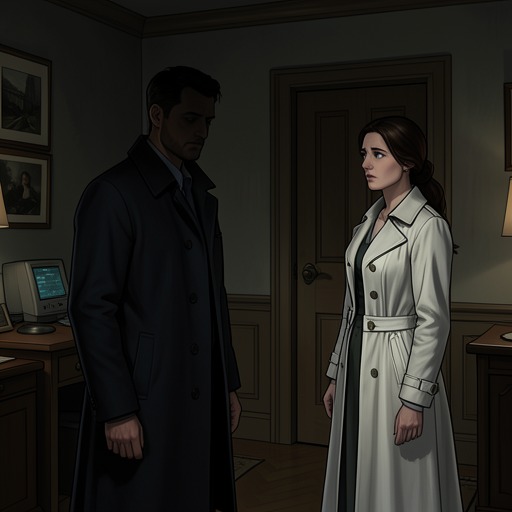
Murder of Anne Simmons
The Book of MirrorsThe murder of Anne Simmons is the event that turns the apparently settled life of a Princeton, New Jersey, couple into a criminal case—and, through Joseph Wieder’s assessment of Derek Simmons, a question about whether the accused man could remember his own actions. The account reaches the reader retrospectively: Laura Baines tells Richard Flynn what she learned from Wieder, so the killing is presented through several layers of testimony rather than as a directly witnessed scene. An affair and a trail of suspicious circumstances point toward Derek, while his persistent claim of innocence and Wieder’s diagnosis complicate the apparent explanation.
The Marriage and the Night of the Killing
Anne and Derek had been married for five years and had no children. Derek worked as a maintenance man; Anne was a waitress at a coffee shop on Nassau Street. Neighbours and family friends later described them as a happy couple who did not argue. That public picture makes the case’s later account of an affair and a possible marital confrontation especially consequential: the murder appears not as the culmination of a known pattern of conflict, but as a rupture in a marriage others believed was peaceful.
Derek said that he returned home at about seven in the evening after shopping nearby, ate, watched television, and went to bed. Anne was working the evening shift and, he said, was not expected home until late. Early the next morning, he called for an ambulance and told the operator that his wife was seriously ill. Paramedics found Anne lifeless in the hall, in a pool of blood, with repeated stab wounds to her neck and chest. An assistant medical examiner pronounced her dead at the scene, and investigators were called in. The account establishes the stark sequence of discovery and response, but it does not show the killing itself or independently settle what happened between the couple that night.
Evidence and the Prosecution Theory
Investigators found that Anne had been having an affair for several months. Her lover’s identity was never discovered—or at least never made public—but the relationship appeared serious: the two reportedly planned to marry after Anne filed for divorce. On the night she died, Anne finished work and locked the café at around ten. She and her lover went to a cheap, one-bedroom apartment on the same street, which Anne had rented two months earlier, and stayed until around midnight. A taxi driver and the meter record placed her return home at 1:12 a.m.
Derek said he knew nothing about the affair. Investigators considered that claim highly unlikely and saw jealousy as a possible motive. They also noted defensive wounds on Anne’s arms, consistent with an attempt to ward off an attacker using a large knife. Two neighbours later said they had heard screams, though neither called the police because the sounds stopped before they had fully woken. These details strengthened suspicion, but they did not directly identify the killer. The lover remained unknown, and the evidence about the murder was assembled into a theory rather than witnessed as a complete sequence.
That theory placed Anne’s return at 1:12 a.m., followed by an argument in which Derek confronted her about the affair and she may have said she intended to seek a divorce. Detectives proposed that about two hours later he took a knife from the kitchen and killed her, disposed of the weapon, and called an ambulance as though he had only just found her body. The proposed sequence made the ambulance call appear to be part of a cover story. Yet the account presents it as the detectives’ reconstruction, not as an established confession; Derek continued to claim he was innocent and refused to accept a deal.
Wieder’s Diagnosis and the Case’s Uncertainty
The accusation was further complicated by Derek’s history of mental illness. As a teenager, he had suffered a severe breakdown and spent two months at Marlboro mental hospital, missing his final year of high school. He had been diagnosed with schizophrenia and continued taking medication after his release. Once a very good student, he abandoned the prospect of college, qualified as an electrician, and took a low-level job at Siemens. The history gave investigators and his lawyer grounds to consider his mental state, but it did not by itself prove what had happened on the night Anne died.
After examining Derek several times, Wieder concluded that the earlier schizophrenia diagnosis was wrong and that Derek had a rare dissociative disorder involving periodic fugue states. In such episodes, a person could lose self-awareness, memory, and a sense of identity; in extreme cases, people might disappear and live under a different identity without remembering their former life. Wieder thought it possible that Derek did not remember what he had done, if he had acted during a state brought on by stress and the altered consciousness of moving suddenly from sleep to waking. This possibility does not confirm either the killing or Derek’s innocence; it changes the central question from motive alone to the relationship between action, memory, and responsibility.
Wieder’s report persuaded the court to commit Derek to Trenton mental hospital alongside other potentially dangerous patients. With the institution’s and his lawyer’s agreement, Wieder continued treating him through therapy that included hypnosis and an experimental mixture of anticonvulsant drugs. The murder therefore has consequences beyond the investigation: it becomes the reason Derek is confined and treated, while the diagnosis that helps explain his possible memory loss also leaves the case dependent on a disputed account of his mental state. As Laura relays the history to Richard, the killing remains both the case’s decisive crime and the point at which apparently clear evidence gives way to uncertainty.